Ahrefs says your page gets 200 visitors a month. Google Search Console says 40. Who do you believe?
This isn’t a thought experiment. It’s what I saw over and over at Keuze.nl. Pages that Ahrefs claimed pulled thousands of visitors actually got a fraction of that. And the reverse: pages Ahrefs ignored because they had “no volume” were quietly generating hundreds of clicks per month from long-tail queries that simply weren’t in their database.
If you’re doing SEO seriously and basing decisions on estimated data, you’re making the wrong calls. That’s it. And that’s why picking the right ahrefs alternative isn’t about comparing feature lists. It’s about the quality of data you’re building your strategy on.
What Ahrefs actually measures (and what it doesn’t)
Ahrefs crawls the web and builds its own index. They estimate traffic based on two things: their keyword database (which search terms exist and their volume) and assumed click-through rates per position.
Sounds reasonable. But there are fundamental holes:
Their keyword database is incomplete. New search terms, niche queries, long-tail variations. If it’s not in their database, it doesn’t exist. Google processes billions of unique queries every day. No third-party tool catches all of them.
Click-through rates vary wildly. Ahrefs uses average CTR curves per position. But actual CTR depends on dozens of factors: featured snippets, ads, shopping results, the specific SERP layout, your title tag, your brand recognition. An average CTR curve is a rough approximation at best.
The data lags. Ahrefs’ keyword database gets updated periodically. Weeks behind reality, sometimes months. If you lost a position last week, you’ll see it in Search Console today. In Ahrefs? Maybe in three weeks.
For keyword discovery, Ahrefs is fine. “What search terms exist in my niche?” It’s good at that. But for understanding what’s actually happening with your site? You’re working with guesses.
The gap is bigger than you think
Let’s get specific. A page ranks at position 4 for a head keyword.
Ahrefs estimates: 200 clicks/month. Based on search volume times average CTR for position 4.
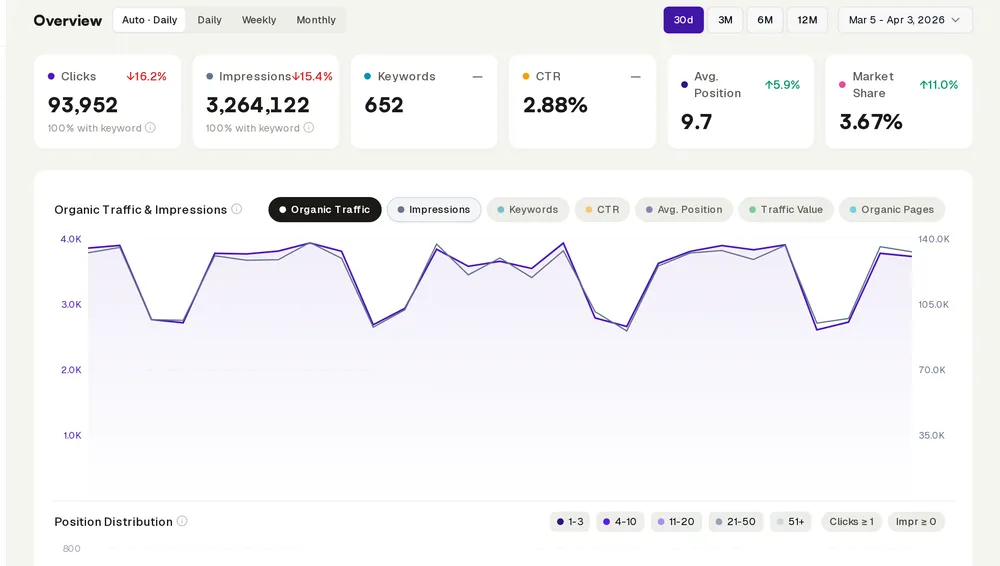
Google Search Console measures: 40 clicks/month. Because there are 4 ads above you, a featured snippet, and a “People Also Ask” box pushing organic results down the page. The real CTR for position 4 here isn’t 8%. It’s 1.5%.
That’s off by 5x.
It works the other way too. That niche page Ahrefs ignores because the target keyword has “too little volume”? It ranks for 50 long-tail variations pulling 5-10 clicks each per month. Total: 300 clicks/month. Ahrefs says: 0.
If you want to compare seo tools, start here. Not at features or interface. At the data.
Why this affects every SEO decision you make
This isn’t an academic distinction. It concretely changes what you do:
Wrong priorities. You spend time on pages that Ahrefs says generate the most traffic. But the real distribution looks different. You’re optimizing the wrong pages while neglecting your actual winners.
Missed problems. A page is losing traffic, but Ahrefs’ estimation model doesn’t pick up the drop. Meanwhile your real traffic has been declining for weeks. By the time Ahrefs shows it, you’ve lost hundreds of clicks.
Overestimated results. You “improve” a page and Ahrefs shows a traffic increase. You celebrate. But Search Console shows a flat line. The improvement only existed inside the estimation model.
Every decision you make on bad data is a bad decision. It doesn’t matter how good your strategy is if the input is wrong.
But data alone isn’t enough
Here’s the thing most people miss when they’re looking for an ahrefs alternative.
Say you have perfect data. Real clicks, real impressions, real positions from Search Console. Even then, Ahrefs (or any traditional SEO tool) is exactly that: a tool. You open it, export data, build spreadsheets, interpret the numbers, come up with a plan, and execute it. That takes hours every week. And it requires you to have the SEO expertise to turn data into action.
Most people don’t have that expertise. So they hire an agency at $2,000+ a month.
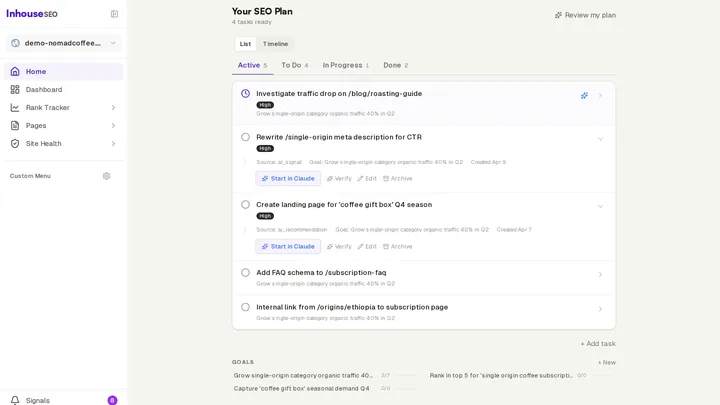
InhouseSEO does something fundamentally different. It takes your real data and interprets it for you. Not “here are your numbers, good luck” but:
- Content plans. Which pages to write, which to update, in what order, with complete briefs based on SERP analysis.
- Link building. Who links to your competitors but not to you, with concrete outreach angles.
- Technical fixes. Crawl issues and indexation gaps, prioritized by impact, with the exact fix included.
- Competitor responses. A competitor publishes something new for your keyword, you know immediately and get a plan.
- Proactive monitoring. You don’t need to open anything or check dashboards. You hear about it when action is needed.
The difference isn’t better data vs. worse data. The difference is: a tool that shows you data vs. an expert that tells you what to do.
InhouseSEO vs Ahrefs: the real comparison
The usual way to compare SEO tools is a feature table. Does it have keyword research? Check. Backlink analysis? Check. Rank tracking? Check.
That completely misses the point.
The real comparison is: tool vs. expert. Ahrefs is a toolbox. A very good toolbox. But you need to know which tool to grab and when, and you need to know how to use it.
InhouseSEO is the specialist who brings the toolbox. Who knows your site, tracks your competitors, diagnoses your problems, and tells you what to do. You don’t need to be an SEO expert yourself.
Read the full InhouseSEO vs Ahrefs comparison if you want the details. But the core of it is this: it’s not about features. It’s about whether you want a tool or an expert.
What you get for €49/mo
Ahrefs Lite costs $129/month. You get estimated data and a set of tools you have to operate yourself.
InhouseSEO costs €49/month. You get:
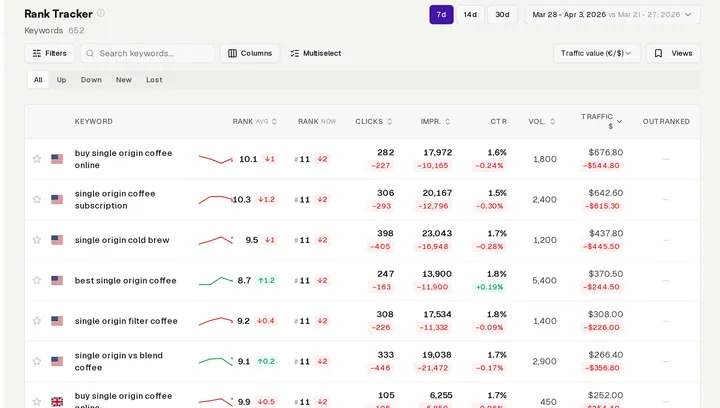
- Real data from Google Search Console, stored permanently, no 16-month limit
- Enriched with search volume, CPC, and competition data
- Continuous monitoring of your entire site
- Diagnoses and action plans when something changes
- Content briefs, link building plans, technical audits
- Everything an SEO agency does, but 24/7 and without the $2,000/month invoice
The question isn’t whether you should replace Ahrefs. The question is whether you want a tool that shows you data, or an expert that tells you what to do with it.
Start your free trial →