Claude is the best SEO analyst in the world. It just doesn’t know your site yet.
That’s not a knock on Claude. It’s genuinely brilliant at understanding search intent, analyzing content gaps, spotting keyword cannibalization, and building strategies. The problem is context. When you paste a CSV export and ask “how to use Claude for SEO,” you get the same advice everyone else gets. Generic. Safe. Useless.
The difference between a €2,000/mo SEO agency and a random ChatGPT prompt isn’t intelligence. It’s that the agency has your data. Your rankings. Your competitors. Your history. Give Claude the same context, and it outperforms most agencies. We’ve seen it happen hundreds of times.
Built by Sander, who scaled Keuze.nl to millions of organic visitors using these exact SEO practices. InhouseSEO is the bridge between Claude’s brain and your Google data.
Why Claude Gives Generic SEO Advice (And How to Fix It)
Ask Claude “how should I improve my SEO?” right now. You’ll get something like:
- “Focus on long-tail keywords”
- “Improve your page speed”
- “Build quality backlinks”
Technically correct. Practically worthless. It applies to literally every website on the internet.
The problem isn’t Claude. The problem is Claude is working blind. It doesn’t know you rank #4 for your most important keyword and a competitor just published a page targeting it. It doesn’t know your blog has 47 posts but only 6 drive traffic. It doesn’t know your site has crawl errors killing your indexing.
Without your real Google Search Console data, Claude is just a very smart person guessing.
What Happens When Claude Actually Knows Your Site
Here’s a before/after from an actual InhouseSEO user (B2B SaaS, ~200 pages):
Before. Claude without data:
“You should create more long-form content targeting high-intent keywords and build backlinks through guest posting.”
After. Claude with InhouseSEO:
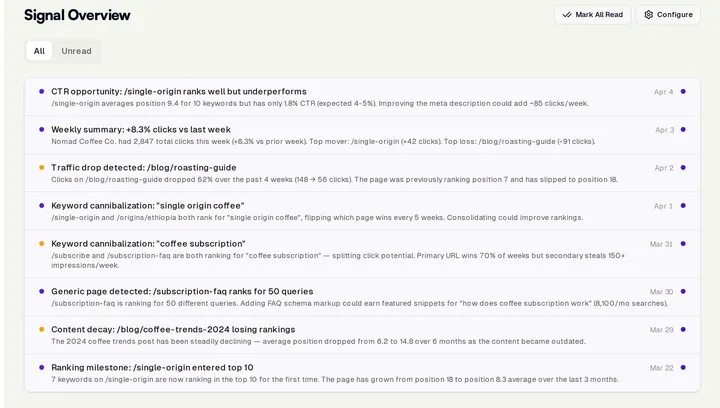
“Your /features page ranks #11 for ‘project management for agencies’ (1,900 searches/mo). You’re 50 clicks away from page 1. The top 3 results all have comparison tables and pricing sections. Yours doesn’t. Add those two sections and you’ll likely break into the top 10 within 4-6 weeks. Meanwhile, your blog post from October on ‘agency workflow tools’ is cannibalizing that same keyword. Consolidate or re-target the blog post to ‘agency workflow automation’ where you have no coverage.”
One answer is something you’d read and forget. The other is something you’d act on today. That’s the difference real data makes.
How to Connect Claude to Your Real Google Data
Three steps. Takes about 2 minutes.
-
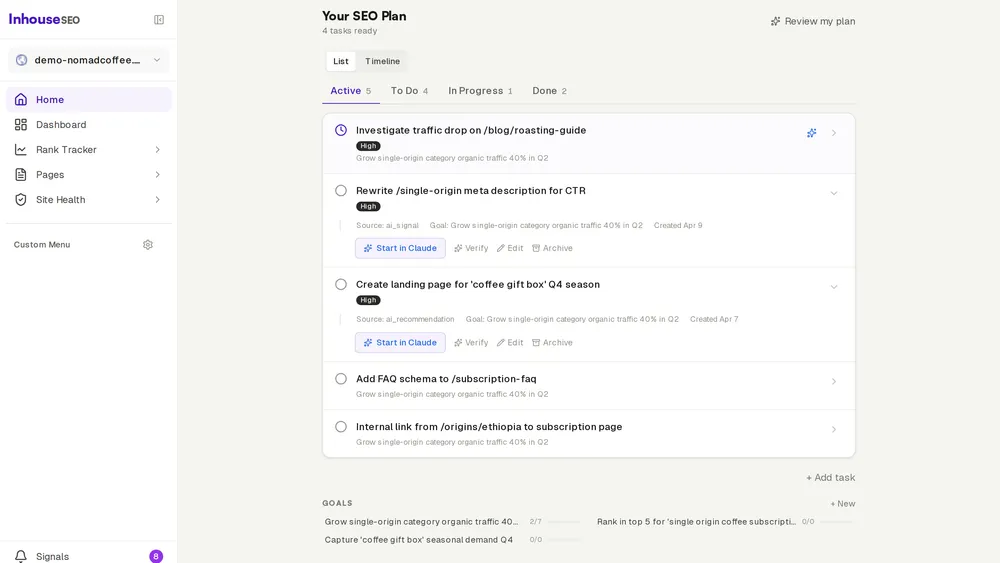
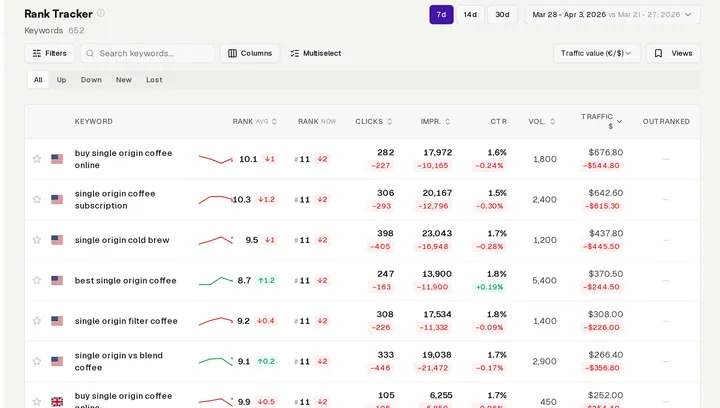
Sign up at app.inhouseseo.ai and connect your Google Search Console. One OAuth click and we pull your real clicks, impressions, positions, and pages.
-
Install the MCP connector. One click from your dashboard. This is what lets Claude talk directly to your data. No copy-pasting. No CSV exports. Live connection.
-
Open Claude and ask your first question. That’s it. Claude now has full access to your rankings, your competitors, your content performance, and your technical health. Ask it anything.
No API keys. No prompt engineering. No 45-minute setup tutorials. If you can connect Google Search Console and install a browser extension, you’re done.
What to Ask Claude First
Once connected, these five questions will show you exactly what Claude can do with real data. Each one replaces hours of manual work.
”What should my content strategy be this quarter?”
Claude analyzes your current rankings, identifies gaps where competitors get traffic and you don’t, cross-references with search volume and your domain’s realistic ranking potential, and delivers a prioritized quarterly content plan. Not a list of keywords. A sequenced plan with SERP-analyzed briefs for each piece, telling you what to cover, what angle to take, and which existing pages to interlink with.
An agency content strategist spends a full day building this. You get it in 30 seconds.
”My traffic dropped last week. What happened?”
Root cause analysis in seconds, not hours. Claude checks whether it was a title tag change you made, a competitor publishing new content, a Google algorithm update, a seasonal shift, a technical issue, or keyword cannibalization between your own pages.
You don’t get “traffic declined 12%.” You get: “Your /pricing page lost 4 positions because competitor.com published a comparison page targeting your #1 keyword last Wednesday. Here’s exactly how to update your page to recover."
"What are my competitors doing that I should worry about?”
Claude tracks competitor sitemaps and SERP movements weekly. You get specific threats with specific response plans: who published what, who’s climbing for your keywords, where you’re losing ground, and what to do about each one before they overtake you.
”Write me a content brief for [topic]”
This isn’t a generic template. Claude analyzes what’s currently winning in the SERP for your target keyword, maps the entities and subtopics the top results cover, identifies gaps in competitor content you can exploit, and accounts for your existing rankings on related terms. The brief includes outline, word count target, internal linking strategy, and the specific angle that gives you a differentiation edge.
This is the methodology real SEO consultants use for content briefs. Except they charge €300-500 per brief.
”Build me a linkbuilding plan”
Claude analyzes your competitors’ backlink profiles, identifies sites that link to similar content but not yours, and creates a targeted outreach strategy with specific angles for each prospect. Not “build quality backlinks.” More like: “these 12 sites link to your competitor’s comparison guide. Your content is stronger on pricing transparency and integration coverage. Here’s a personalized outreach angle for each.”
Claude + InhouseSEO vs. an SEO Agency
The honest comparison:
| SEO Agency | Claude + InhouseSEO |
|---|
| Monthly cost | €2,000-5,000 | €49/mo |
| Response time | 24-48 hours | 30 seconds |
| Data source | Usually Ahrefs estimates | Your real Google data |
| Availability | Business hours, account manager’s schedule | Whenever you need it |
| Content briefs | 2-4 per month | Unlimited |
| Reporting | Monthly PDF | Real-time, on-demand |
| Knows your site | After a few months | From day one |
Where agencies still win: execution. If you need someone to actually write the content, build the links, and implement changes, an agency does that. InhouseSEO tells you exactly what to do. You (or your team, or a freelancer) still need to do it.
But for strategy, analysis, and planning? The gap between a €3,000/mo agency and InhouseSEO is razor thin. And closing fast.
Is This Actually Better Than Ahrefs + ChatGPT?
The question everyone asks. Fair enough.
Ahrefs gives you estimated data. Keyword volumes are modeled, not real. Positions are sampled, not from Google. Traffic numbers are projections. You’re making decisions based on approximations.
InhouseSEO feeds Claude your actual Google Search Console data. Real clicks. Real impressions. Real positions. The data Google itself uses to rank you.
Then there’s the workflow. Ahrefs + ChatGPT means: export CSV from Ahrefs → clean the data → paste into ChatGPT → write a good prompt → interpret the output → figure out what to do. That’s 30-60 minutes per question.
InhouseSEO: ask Claude the question. Get the answer. Act on it.
We wrote a full comparison of InhouseSEO vs. Ahrefs if you want the detailed breakdown. The short version: Ahrefs is a great research tool. InhouseSEO is your SEO team.
Start in 2 Minutes
Connect your Search Console. Install the connector. Ask Claude what to work on first. You’ll know within one conversation whether this replaces your current setup.
No credit card required. No 14-day trial that expires before you use it. Just connect and ask.
Start free trial →