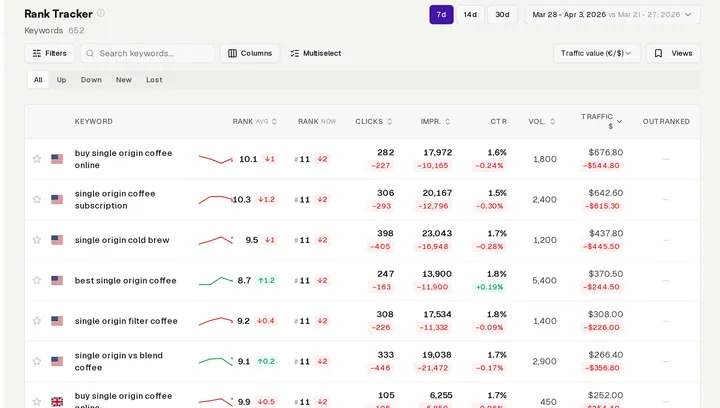
You open Ahrefs. 10,000 keywords. 47 charts. 12 tabs. You close the laptop and do something else. Sound familiar?
You’re not lazy. You’re not bad at SEO. The tool failed you. It handed you a warehouse full of boxes and said “the answer is in here somewhere.” Finding the best SEO tool in 2026 isn’t about finding more data. It’s about finding one that actually tells you what to do with it.
After building Keuze.nl to millions of organic visitors, Sander learned something that most SEO tools don’t want you to know: the gap between data and results isn’t more data. It’s expertise. And that gap is where most companies waste thousands of hours and dollars every year.
The Dashboard Trap: Why More Data Makes SEO Harder
SEO tools are built by data companies. Their business model rewards showing you MORE. More keywords, more metrics, more charts, more tabs, more features to justify the subscription.
Ahrefs tracks 10+ billion keywords. Semrush has 55+ tools in its suite. Moz gives you a different score for everything. The result isn’t clarity. It’s paralysis.
A survey by Databox found that SEO professionals spend 15-20 hours per month just collecting and analyzing data. Before fixing a single thing. That’s half a work week every month spent staring at dashboards instead of improving your site.
The cruel irony: the sites that grow fastest are usually the ones where someone ignores 95% of the data and focuses on the 5% that matters. The tools make finding that 5% nearly impossible because every metric is presented as equally important.
Every tool added AI in the last two years. Ahrefs has an AI assistant. Semrush launched “AI Content Tools.” A dozen startups put “AI-powered” in their tagline.
Here’s what actually happened: they wrapped a chatbot around the same dashboards. The AI still doesn’t know your site. It doesn’t know your competitors changed strategy last month. It doesn’t know that your best page is cannibalizing your second-best page. It doesn’t have your real Google data.
Most “AI SEO tools” work like this: pull data from their own estimated database, dump it into an LLM prompt, return a generic response with your keyword inserted. It’s Mad Libs with a language model.
You can test this yourself. Ask any AI SEO tool “what should I work on this week?” If the answer could apply to literally any website, the AI doesn’t actually know anything about yours.
Hire a great SEO consultant, someone who’s actually grown sites and not someone who sells courses about it, and watch what they do. It looks nothing like using a tool.
They start with your real data. Not estimated keyword volumes from a third-party database. Your actual Google Search Console numbers. Real clicks, real impressions, real positions from Google itself.
They cross-reference everything. Your rankings against competitor movements. Your content against what’s actually winning in the SERP. Your technical health against your indexing patterns. No single metric in isolation.
They prioritize ruthlessly. Out of 10,000 keywords, they identify the 15 that matter this quarter. Out of 200 pages, they find the 5 that need attention right now. They ignore everything else.
They give you specific actions. Not “improve your content quality.” Instead: “Add a comparison table to your pricing page, expand section 3 with these two subtopics, and change your title tag from X to Y. This will likely move you from position 7 to top 5 for this keyword within 6 weeks.”
They do this proactively. They don’t wait for you to log in and ask. They monitor weekly and flag problems before they become crises.
That’s what €2,000-5,000/month buys you. Not data. Expertise applied to data.
Data vs. Expertise: A Side-by-Side
Here’s what the same situation looks like through a tool versus through an expert:
| Situation | What a tool says | What an expert says |
|---|
| Content planning | ”These 50 keywords have search volume in your niche" | "Here are 5 articles to write this quarter, in priority order, with SERP-analyzed briefs. Article 1 targets a gap where your closest competitor gets 2,400 clicks/mo and you have nothing. Article 2 strengthens your existing cluster around [topic] where you already rank for 12 related terms.” |
| Rankings drop | ”Position changed from 3 to 7" | "You dropped because competitor.com published a 3,000-word comparison guide last Wednesday. Your page is 800 words and missing pricing and integration sections. Add those sections using this outline and you’ll recover within 3-4 weeks.” |
| Linkbuilding | ”Your DR is 23. Your competitor’s DR is 45." | "Here are 12 sites that link to your competitor’s guide but not yours. Your content is actually stronger on implementation details. Here’s a personalized outreach angle for each site, with email templates and the specific page of yours to pitch.” |
| Technical SEO | ”47 crawl errors found" | "3 of these 47 errors are actually hurting your rankings. Your /blog canonical tags are pointing to the wrong URLs, costing you ~200 clicks/month on your best content. Here’s the fix. Takes 10 minutes.” |
| Keyword opportunity | ”You rank #11 for ‘project management pricing’" | "You’re 50 clicks away from page 1 for a keyword worth €3,200/mo in traffic value. The top results all have comparison tables. Add one to your existing page and you’ll likely cross into the top 10 without any new content.” |
| CTR optimization | ”Your CTR is 2.1%" | "Your CTR is half of what position 5 normally gets. Your title is the problem. It reads like a feature description instead of answering the searcher’s question. Change it to [specific suggestion] and expect CTR to double within 2 weeks.” |
The left column costs $99-249/month. The right column costs €2,000-5,000/month from an agency. The question is whether there’s a third option.
What If You Could Hire the World’s Best SEO Team for €49/mo?
That’s not a hypothetical. That’s what InhouseSEO does.
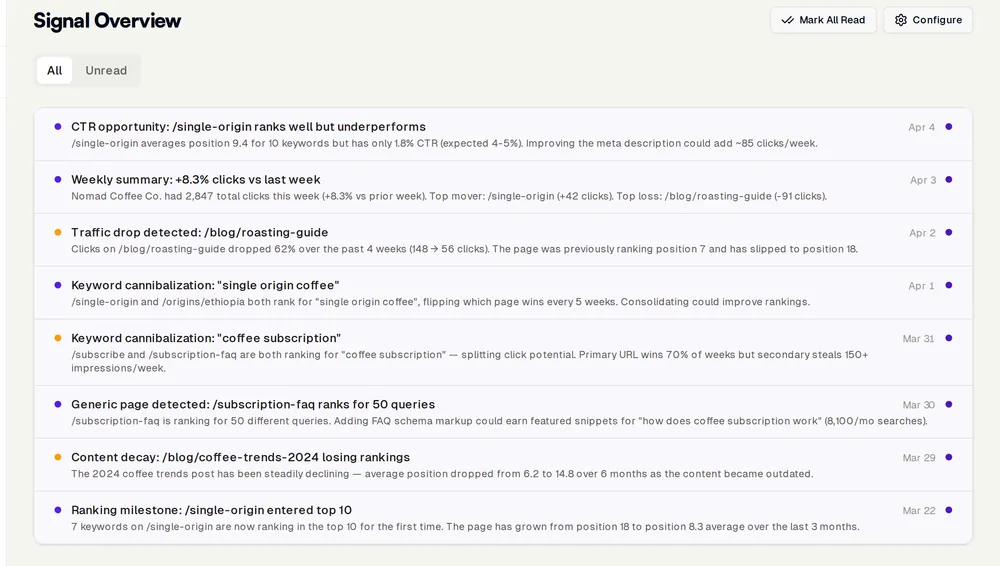
InhouseSEO connects your real Google Search Console data to Claude. Not through CSV exports or copy-pasted prompts, but through a live connection that gives Claude full access to your rankings, competitors, content performance, and technical health.
The result: every conversation with Claude becomes a conversation with a senior SEO consultant who knows your site inside out. You get the right column of that table above, not the left.
This works because Claude is genuinely exceptional at SEO analysis when it has the right data. The problem was never the AI. The problem was that nobody gave it real data to work with. InhouseSEO fixes that.
Check the pricing →
How It Actually Works
Three steps. No setup calls. No onboarding meetings. No “implementation timeline.”
Step 1: Connect your Google Search Console. One OAuth click. InhouseSEO pulls your real data (clicks, impressions, positions, pages) and stores it permanently (no more GSC’s 16-month data cliff).
Step 2: Install the MCP connector. One click from your dashboard. This creates the live connection between Claude and your SEO data. No API keys, no configuration files.
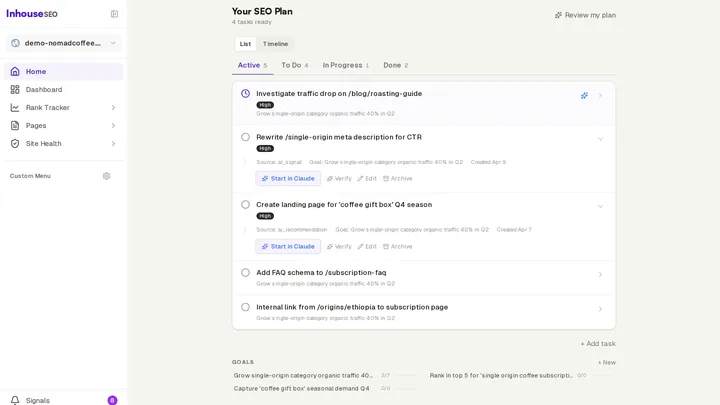
Step 3: Ask Claude what to work on. That’s it. You now have a senior SEO team that knows your site, tracks your competitors, and gives you specific actions instead of dashboards. See exactly how it works on the product page.
The first answer you get will tell you whether this replaces your current tool, your agency, or both. Most people know within 5 minutes.
Stop Paying for Data You Can’t Use
Every month you spend with tools that only give you data, you’re paying for the privilege of doing the hard part yourself. The analysis. The prioritization. The “what does this actually mean for my site?” The seo tools comparison you should be making isn’t about features or data volume. It’s about whether the tool tells you what to do or makes you figure it out.
The best SEO tool is the one that makes the right next action obvious. For thousands of sites, that’s Claude with real data.
Start free trial →