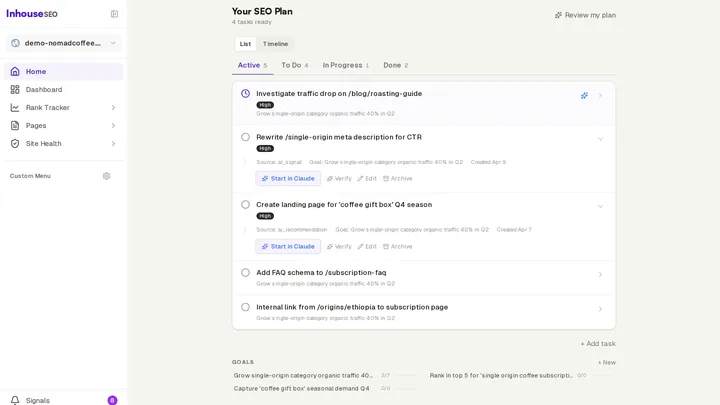
seo claude
How to Use Claude for SEO: Complete Guide
Connect Claude to your real Google Search Console data and turn it into a senior SEO specialist. Step-by-step guide with real examples.
InhouseSEO, Editorial Mar 17, 2026 · 6 min read
11 Claude skills for SEO we use at InhouseSEO: page audits, content briefs, keyword plans, E-E-A-T scoring, linkbuilding. Free on GitHub, Apache 2.0.
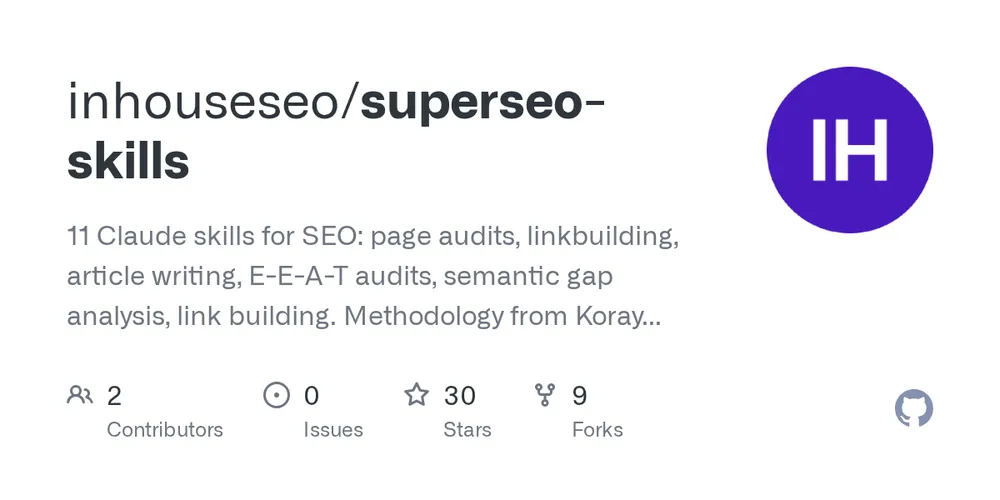
Eleven of the 24 Claude skills for SEO we run at InhouseSEO are now on GitHub. Free, Apache 2.0, fork them and use them on client work tomorrow.
The repo went up four days ago. It has 30 stars at the time of writing, which is more than I expected for a niche pack of SEO prompts, so I’m writing this post a bit earlier than planned.
These are the skills that need nothing but Claude and a browser. Page audits. Content briefs. Keyword plans. E-E-A-T scoring. Topic clusters. Featured snippet rewrites. Linkbuilding playbooks. Expert interviews. And a few more. The other 13 skills, the ones that watch your Search Console history and your competitors every day, still live on the platform. More on that split below.
Repo: github.com/inhouseseo/superseo-skills
I got tired of reading SEO “prompt packs” that are 40 bullet points long and refuse to commit to anything. The kind where every recommendation is hedged, every framework promises to cover everything, and nothing tells you what to do on Monday morning.
These Claude skills for SEO are the opposite. Give them a URL and they fetch the page, Google the primary keyword, read the top three results, and return an audit that takes a position. Give them a keyword and they read the top ten, classify the intent, map the gap, and produce a brief a writer can actually work from. No “paste your GSC export here.” No “please describe your business in 500 words first.” The agent does the research itself.
The methodology isn’t mine. I lifted it, openly, from the people who have been right the longest:
None of those four wrote these skills. But if you have read them and nodded along, you will recognise the bones.
The 11 free skills are page audits, content briefs, keyword deep-dives, semantic gap analysis, E-E-A-T scoring, content writing, content rewrites, topic cluster planning, featured snippet optimization, linkbuilding playbooks, and expert interview scripts. Each one is a self-contained Markdown file that runs in Claude Code, Claude Desktop, or any agent that reads prompts.
11 skills. page-audit, content-brief, keyword-deep-dive, semantic-gap-analysis, eeat-audit, write-content, improve-content, topic-cluster-planning, featured-snippet-optimizer, linkbuilding, expert-interview. Each one is a single SKILL.md you can drop into Claude Code, paste into a Claude.ai Project, or copy into a Cursor rule.
23 content-type templates. How-to, comparison, listicle, pillar page, glossary, location page, integration page, buying guide, alternatives page, category page, product page, and the rest. Each with H1/H2 structure, schema markup, featured snippet format, word-count targets, and the E-E-A-T signals that matter for that specific type.
9 linkbuilding playbooks. Guest posting, broken link building, skyscraper, resource pages, competitor backlink gap, entity stacking, citations, strategic partnerships, podcast guesting. Every one is a step-by-step with realistic conversion rates from the field, not agency pitch-deck numbers.
An anti-AI-slop ruleset. This is the piece I care about most. It is not a humanizer. There is no second model that “rewrites for voice.” The skill is told, at the moment of writing, not to use a specific list of words and patterns that function as AI tells, and to take positions instead of hedging. I wrote this blog post under that ruleset. If a sentence here still smells like a robot, that’s on me, not the prompt.
Fair question, since the platform still costs money.
The repo skills start cold every session. They read a page, research the SERP, compare your page to the top three, and tell you what to change right now. What they cannot do is remember. They don’t know what your rankings were last Tuesday, they don’t know the page on your site that has been decaying for six weeks in the background, and if a competitor jumped you on Monday, they will only find out when you ask. Because they don’t know you have competitors at all unless you tell them every session.
That is the honest split. If your SEO doesn’t need memory, the repo is enough. For one site you touch weekly and prefer to do the thinking on yourself, I would use the repo and save the subscription.
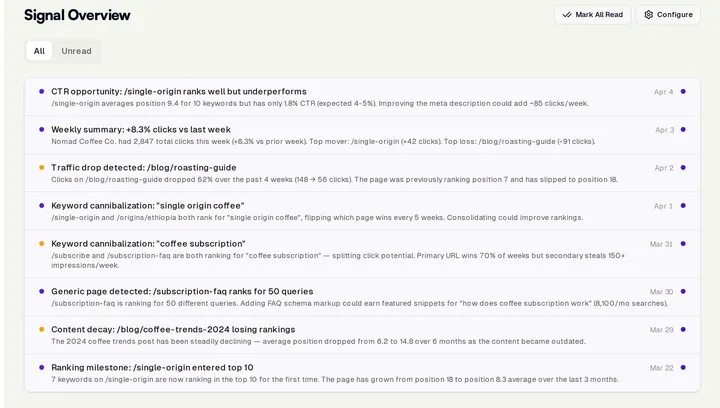
The platform adds 13 more skills that only make sense once someone is storing your Search Console history and watching your competitors every day: weekly-report, keyword-opportunities, traffic-decline-recovery, content-decay, cannibalization, top-movers, ranking-changes, compare-periods, technical-health, internal-links, index-coverage, serp-features, competitor-intelligence. Plus nine more linkbuilding playbooks: link reclamation, existing-relationship outreach, testimonial building, broken-link building at scale, reactive and proactive digital PR, linkable assets, niche edits, and ego bait. They need a data warehouse behind them to run, and they’re worth more than everything in the repo put together. That’s what InhouseSEO is for.
If you use Claude Code, the fastest way is the plugin marketplace:
/plugin marketplace add inhouseseo/superseo-skills
/plugin install superseo@superseo-skills
Every skill is now auto-discoverable. Ask Claude to “run a page audit on example.com” and the page-audit skill will load automatically, references and all.
If you prefer a manual clone:
git clone https://github.com/inhouseseo/superseo-skills.git
cp -r superseo-skills/skills/* ~/.claude/skills/
Restart, then ask Claude to run a page audit on any URL.
If you use Claude Desktop or the Claude.ai web app, paste any SKILL.md into a Project as custom instructions. Each file is self-contained and works standalone.
If you use Cursor, the README has the rules-directory copy command. Same for any other agent that reads markdown.
One honest split, because I keep getting asked this.
Use the repo if you run SEO for one site and you like doing the thinking yourself. The skills will give you the research and the draft. That’s the Sunday-afternoon crowd.
Use InhouseSEO if you want something watching the site every night, catching decay before you notice, writing the weekly report before you open the dashboard, and diagnosing a traffic drop with attribution instead of a list of possible causes. If you’re also weighing another rank tracker, we wrote the comparison to Ahrefs.
The 7-day free trial gives you the platform and the 13 extra skills. If it doesn’t pay for itself in the first week, tell me. I read the email.
If you fork the repo, improve something, and the improvement is actually better, send a PR. The contributing guide is honest about the bar: take a position, cite a primary source, write in your own voice, and pass the skill’s own anti-slop audit before you push.
If you use the repo for client work and it saves you a Sunday, that’s exactly what it was written for.
Written in by Sander van Meggelen Founder in ai seo claude open-source
Share this article:
Connect Claude to your real Google Search Console data and turn it into a senior SEO specialist. Step-by-step guide with real examples.
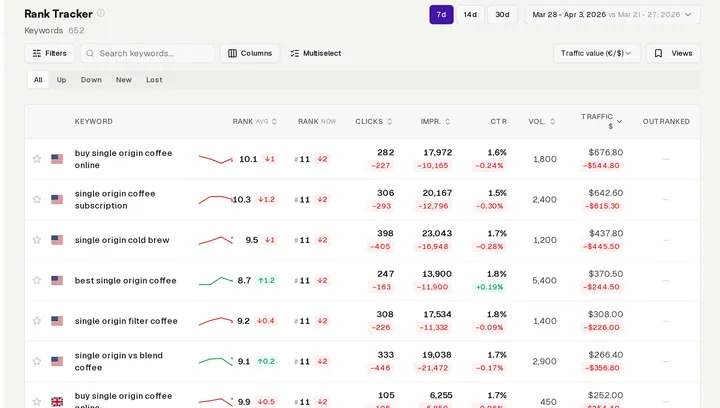
GSC is the most valuable free SEO tool. But it has hard limits that cost you rankings every day. Here's what you're not seeing.
Every SEO tool floods you with charts and numbers. None of them tell you what to actually do. Here's why, and what's changing.