Claude is the best SEO analyst in the world. It just doesn’t know your site yet.
That’s the entire problem with AI for SEO. People open ChatGPT, type “give me 10 title tags for my project management page” and get generic garbage back. Of course they do. The AI doesn’t know which keywords you already rank for, what your competitors are doing, or what you tried last month. It’s like asking a surgeon to operate without an X-ray.
At Keuze.nl I spent years doing SEO with spreadsheets, Ahrefs exports, and an absurd number of Search Console tabs. AI for SEO was supposed to change that. In practice it meant: manually copy data, type out the context, and hope the output was usable. That had to get better.
Why AI gives you generic SEO advice
The problem isn’t the AI. It’s the input.
Ask ChatGPT “how do I improve my SEO?” and you’ll get a checklist that applies to every website on the internet. Optimize your title tags. Write longer content. Build backlinks. Thanks, I already knew that.
AI for SEO only works when it has three things:
- Your real data. Not estimates. Your actual clicks, impressions, positions, and CTR from Google Search Console.
- Your context. What do you sell? Who’s your audience? Where does your authority sit?
- Your history. What changed? Which pages are climbing, which are dropping, and since when?
Without those three, every AI output is a guess. With them, you get advice a senior SEO consultant would give. In seconds.
What happens when AI actually knows your site
The difference isn’t subtle. It’s the difference between a doctor who has your medical history and a random physician at a walk-in clinic.
Without context: “Why is my page losing traffic?” —> “Here are 10 possible reasons why pages lose traffic.” Useless.
With context: “Your comparison software page is losing ~120 clicks/week since February 14. Competitor X published a more thorough article on February 10 that now sits at position 2. Your article is missing sections on [specific topic] and [other section]. Here’s a content brief to fix it.”
That’s not theory. That’s what happens when you give Claude access to your Search Console data, your site structure, and your competitive landscape.
How it works in practice
A concrete scenario. You have a SaaS product and 80 published pages. You want to know where you’re leaving opportunities on the table.
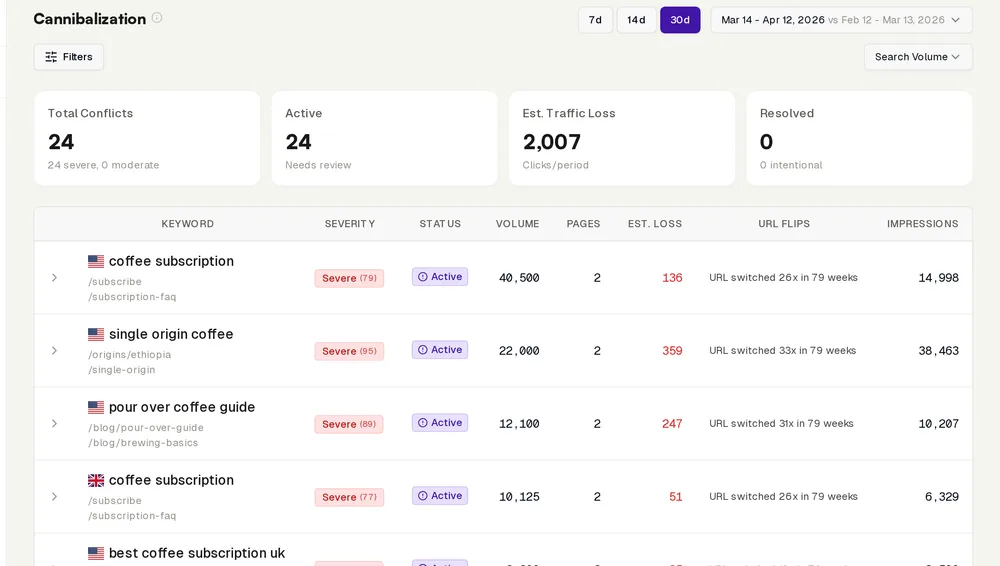
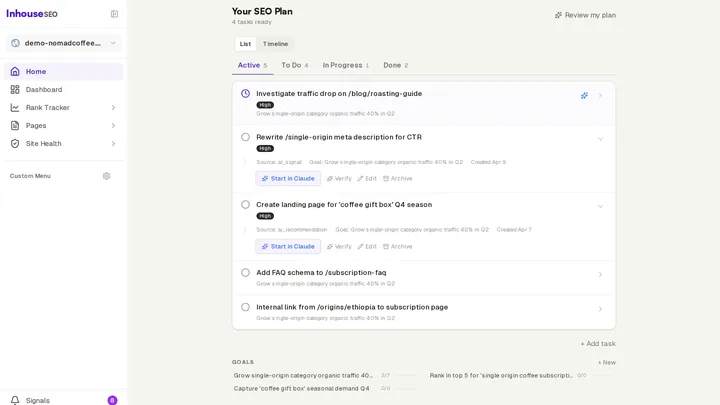
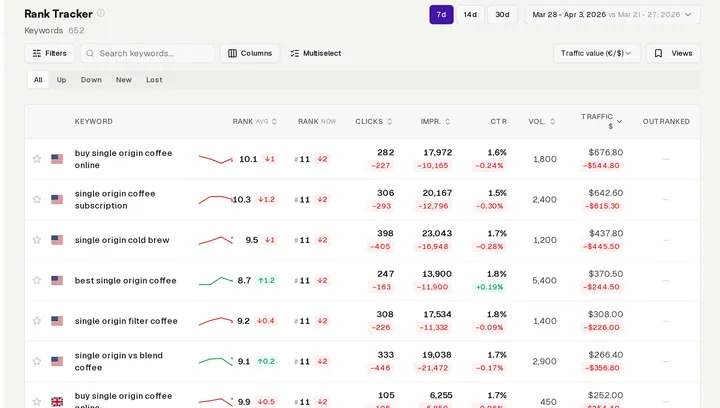
With InhouseSEO, you connect your Google Search Console. Claude automatically gets your full dataset: queries, pages, positions, trends, competitors. No copy-paste. No exports.
You ask: “Where am I leaving the biggest opportunities?”
Claude analyzes your data and comes back with something like: “You have 12 pages ranking at positions 4-10 for keywords with 500+ monthly search volume. The quickest win is your page about [topic], currently at position 6. Your title tag doesn’t match search intent and you’re missing a section that all top-3 results have. Here’s the fix.”
Not a report. A fix.
5 things you can ask tomorrow
This is what AI for SEO actually looks like when the AI knows your site:
1. Content strategy. “Build me a content plan for Q2.” Claude analyzes your content gaps, looks at what competitors are publishing, identifies keywords where you’re missing opportunities, and delivers prioritized briefs. Not “write something about X.” A brief with search intent, SERP analysis, entity mapping, structure, and estimated impact.
2. Traffic diagnosis. “Why has my traffic dropped since last month?” Claude compares periods, identifies which pages and keywords are responsible, and gives you the cause. Competitor outranking you? Algorithm update? Seasonal effect? You get the diagnosis and the action plan.
3. Competitor analysis. “What is [competitor] doing that I’m not?” Claude compares your content, backlinks, and rankings. You see exactly where they’re winning and why, with concrete steps to close the gap.
4. Content brief. “Write a brief for [keyword].” Not a template. A brief based on what’s actually ranking right now. Which entities do the top results cover? Which questions do they answer? Which internal links from your site are relevant? All analyzed, ready to write.
5. Link building plan. “Which backlinks do I need for [page]?” Claude analyzes the backlink profiles of the pages ranking above you, finds sites linking to them but not to you, and builds concrete outreach angles. Not a list of URLs. A plan with pitches.
AI as a gimmick vs. AI as your SEO team
This is where most “AI SEO tools” get it wrong.
They bolt AI onto an existing tool. You get the same dashboards and exports as before, just with a chat window next to them. That’s AI as a gimmick. A feature for the marketing page.
InhouseSEO is different. It’s not a tool with AI bolted on. It’s the best SEO brain in the world (Claude, with full knowledge of your site) working for your startup. Around the clock. Without requiring you to be an SEO expert yourself.
The difference: a tool shows you data. An expert tells you what to do. Compare it to Ahrefs yourself and you’ll see it immediately.
What does this actually cost?
An SEO agency runs $2,500+ per month. A freelance SEO consultant charges $80-150 per hour. Both are limited by human capacity. They can only spend so many hours on your site.
InhouseSEO costs $49 per month. That’s not a stripped-down version. That’s full access to an AI SEO expert that monitors your site 24/7, answers your questions, plans your content, diagnoses your problems, and identifies your opportunities.
No contracts. No minimum commitment. If it doesn’t work, you cancel.
The question isn’t whether AI for SEO works. The question is whether you’re giving it the right input.
Start your free trial —>